How to Trade Meme Coins Without Blowing Up Your Account
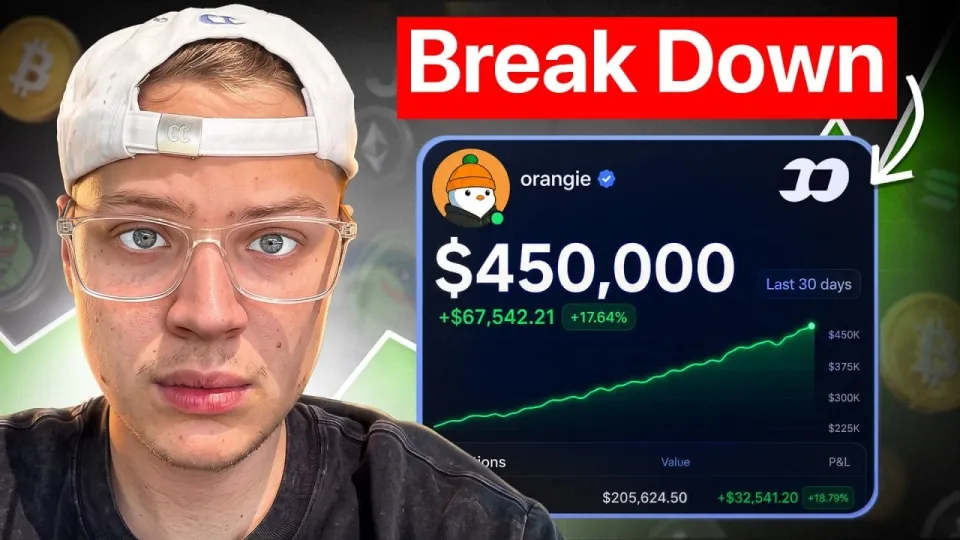
Video: How I Made $450,000 Trading Memecoins in 30 Days
You can order the same kind of articles for your own video to boost it on YouTube and Google. Just message the Telegram bot @sat_sit_bot. It writes articles around your video, embeds the video and publishes them on popular niche websites (no ads). Free trial — 50 articles.
· based on the channel Orangie Web3
Key takeaways
- Orangie Web3 reports turning $450,000 in profit from memecoin trading in 30 days — a result built on many small positions, not one lucky bet.
- Meme coins are launch-first, narrative-driven tokens: most go to zero, so a single winner has to pay for a long string of losers.
- The biggest edge is speed of information — a private group calling coins early beats reading charts alone.
- Survivors size positions small, check liquidity and holder distribution, and take profit in tranches instead of holding for a 100x.
- A 90% drawdown on one position is normal; the account survives only if no single trade can wipe it out.
Meme coins are high-volatility tokens built on a joke, a meme or a viral narrative rather than on revenue or a product, and trading them profitably is mostly a discipline problem rather than a prediction problem: you size every position so a total loss is survivable, you buy early, and you take profit in pieces. The strategy behind a reported $450,000 run in 30 days on Orangie Web3 is exactly that — many small entries, fast exits, and one or two outsized winners paying for everything else. The channel's community and tooling links start with a paid group checkout at the Kaizen Group plan on Whop, which is where the trade calls in the video originate.
What a meme coin actually is and why the odds are stacked
A meme coin is a token whose price depends almost entirely on attention, not fundamentals, which is why the same asset can 10x in an hour and lose 95% the next day. On Solana, where most of this activity happens, anyone can launch a token in minutes through platforms like pump.fun, so supply of new coins is effectively infinite and the average lifespan of a launch is measured in hours. Dogecoin is the historical reference point, but the modern version of the trade is a token with a funny ticker, a Telegram or Discord community, and a liquidity pool that may hold only a few thousand dollars.
That structure produces a specific payoff profile: the median outcome is a loss close to 100%, and the mean is driven by a small tail of tokens that catch a narrative and keep running. Traders who make money in this market are not winning on accuracy — they are winning because their winners are large relative to their losers, and because they never let a single position become big enough to matter.
The mechanics of a trade: entry, liquidity and holder checks
Before buying any meme coin, run the same short checklist every time; the goal is to filter out tokens where you cannot get out, not to find the perfect coin. Speed matters, but a two-minute check saves accounts.
- Liquidity. Compare pool size to your intended position. If you want to put in $2,000 and the pool holds $15,000, your own exit will move the price against you. A rough rule: your position should be a small fraction of liquidity, not a meaningful share of it.
- Holder distribution. A token where one wallet holds 20%+ of supply is a token where one seller can end the chart. Check the top holders and whether the dev wallet has already sold.
- Contract and mint authority. On Solana, confirm the mint authority is revoked and freeze authority is disabled; otherwise the deployer can print more supply whenever they like.
- Narrative and timing. Ask what the coin is a joke about and whether that joke is currently spreading. A memecoin with no story has no reason for the next buyer to arrive.
- Age and volume. A token that has already run 20x before you found it is a different trade from one launched an hour ago — the first is a momentum trade, the second is a lottery ticket.
Position sizing and the math behind a six-figure month
The reason a $450,000 month is possible from a modest starting balance is compounding of small asymmetric bets, not a single all-in call; the math only works if losers are cheap. If you risk 2% of your account per trade and hit a 50x once every few hundred attempts, the winner alone returns your entire account — that is the entire model. Risking 50% per trade does the opposite: two bad entries and you are out of the game before the winner arrives.
A practical structure many traders use:
- Core account — money you will not touch, kept outside memecoin trading entirely.
- Trading stack — the amount you accept losing completely; that number, not your ambition, sets position size.
- Per-trade risk — 1–5% of the trading stack on any single launch, higher only when liquidity and holder data are unusually clean.
- Scaling out — sell a portion at 2x, another at 5x, and let a small remainder run; this converts a volatile chart into realized profit.
One viewer in the comments described losing roughly 90% of a $100 starting position and then recovering with a single 3x on a token — that is a realistic description of the distribution, and also a warning: the recovery worked because the position was $100, not $10,000.
Speed, information and the group-trading question
The most repeated criticism under the video is that the creator trades alongside a private group of experienced traders who call coins early and help each other exit — and that this, more than chart reading, explains the results. That criticism is worth taking seriously rather than dismissing. In memecoins, the edge is information latency: the difference between buying at a $40,000 market cap and a $400,000 market cap is the difference between a 10x and a 2x. A Discord or paid group compresses that latency, and a solo trader refreshing a scanner is structurally slower.
If you are not in such a group, adjust expectations instead of chasing the same returns. Solo traders can still participate, but the realistic path is smaller size, earlier exits, and treating any group you do join as a source of ideas to verify — not as a signal service to follow blindly. The video's own funnel points to a Discord community at https://discord.gg/memecoins and a trading interface through https://fomo.family/r/orangie, both of which are worth evaluating on their own merits before paying for anything.
Common mistakes beginners make in their first month
Most first-month losses come from behavior, not from bad coin selection; the same five errors show up again and again in trader feedback. The first is buying a token that has already gone vertical because the chart looks exciting — by then the earliest buyers are your exit liquidity. The second is refusing to sell: holding a 4x for a 100x usually ends with holding a 4x to zero.
The third is revenge trading after a loss, which turns a 2% drawdown into a 40% one. The fourth is ignoring fees and slippage on Solana swaps, which are small per trade but compound across dozens of entries. The fifth, and most expensive, is treating a lucky win as skill — the trader who 3x'd a position in week one often sizes up five times in week two and gives it all back. Write your exit rules before you enter, and do not renegotiate them while the price is moving.
How to build a repeatable process instead of chasing one hit
A repeatable memecoin process is a written set of rules about what you buy, how much, and when you sell, reviewed weekly against actual results. Track every trade with entry market cap, exit market cap, position size, and the reason you entered; after twenty trades the pattern in your own data will tell you more than any video. Expect the hit rate to be low — a strategy that wins one trade in ten can still be profitable if that winner returns 20x and the losers cost 1x each.
Keep the workflow boring: a scanner for new launches, a wallet separate from your main holdings, a fixed position size, and a rule that you stop for the day after two consecutive full losses. Boredom is a feature here. The traders who survive long enough to catch a large winner are the ones who still have capital when it appears.
Useful links
- Kaizen Group plan (paid community checkout): https://whop.com/checkout/plan_GTFkEFh0JFpU8?a=orangie
- Fomo trading platform referral: https://fomo.family/r/orangie
- Orangie Discord: https://discord.gg/memecoins
- Instagram: https://www.instagram.com/orangieyt/
Final thoughts on trading meme coins
Meme coin trading rewards a very specific temperament: small bets, fast decisions, and no attachment to any single token. The $450,000 figure in this breakdown is a headline, not a benchmark — the transferable part is the structure behind it, where risk per trade stays tiny and winners are allowed to run while losers are cut without argument. Anyone entering this market should assume the first several attempts lose money and size accordingly. The full walkthrough, including the creator's own entries and exits, comes from the Orangie Web3 channel, and the community behind it is linked above at the Kaizen Group checkout if you want to see the calls as they happen.
Questions & answers
How much money do you need to start trading meme coins?
You can start with a small amount, but the number matters less than the rule that you must be able to lose all of it. Pick a trading stack you accept losing completely, then risk only 1–5% of that stack per trade. Starting with $100 and risking $5 per position is a more useful education than starting with $5,000 and risking $1,000.
Is it realistic to make $450,000 in 30 days from meme coins?
It is possible but statistically rare, and it usually requires either a large starting balance or a long string of attempts with one or two huge winners. The reported result also came from a trader operating inside an experienced group with fast information. Treat such figures as an illustration of the payoff structure, not as an expected outcome.
Why do most meme coins go to zero?
Because supply of new tokens is unlimited and most launches have no narrative, no community and thin liquidity. Without a reason for new buyers to keep arriving, the price collapses as soon as early holders take profit. On Solana, anyone can deploy a token in minutes, so attention — not technology — is the scarce resource.
Do I need a paid group or Discord to trade meme coins profitably?
No, but information speed is the main edge in this market, and groups compress it. A solo trader can still be profitable with smaller size, earlier exits and strict rules, while treating any group's calls as ideas to verify rather than instructions to follow. Evaluate any paid community on its track record before committing money.
Source: How I Made $450,000 Trading Memecoins in 30 Days · Markdown version